
Metallica Wins the Loudness Wars
Saturday, December 20th, 2008 | by matthew mcglynn
 There was a great End Rant in Tape Op about the latest Metallica album, Death Magnetic. Mastering Engineer Paul Abbott of Zen Mastering wrote,
The outcry over the un-listenably loud level of Metallica’s Death Magnetic CD has become one of the more visible occurrences of the “loudness wars” in the mainstream media… now, a lowest-common-denominator threshhold has been crossed and the problem has been pushed in our faces.
I don’t pay much attention to the mainstream media, and I don’t pay any attention at all to Metallica — in fact it’s safe to say that I get 100% of my Metallica news from Tape Op, which thankfully means I don’t get very much at all. So I’d missed the outcry. Hell, I’d even missed the release of Death Magnetic.
In a hurry? Scroll down to find the audio clips comparing Death Magnetic CD vs. “Guitar Hero” audio. Disclaimer: prepare to be ill.
The story caught my interest. As Paul noted in his rant, the loudness of the CD was made more notable by the near-simultaneous release of an alternate mix — with much more conservative limiting and compression — via Activision’s “Guitar Hero” game. Suddenly, A/B comparisons illustrating the casualties of the loudness war can be easily made. For example, see below.
An associate of mine provided loaner copies of both mixes of the album. A few minutes of research at Last.fm revealed that the most popular track is “The Day That Never Comes,” so I loaded both versions of that song into Pro Tools.
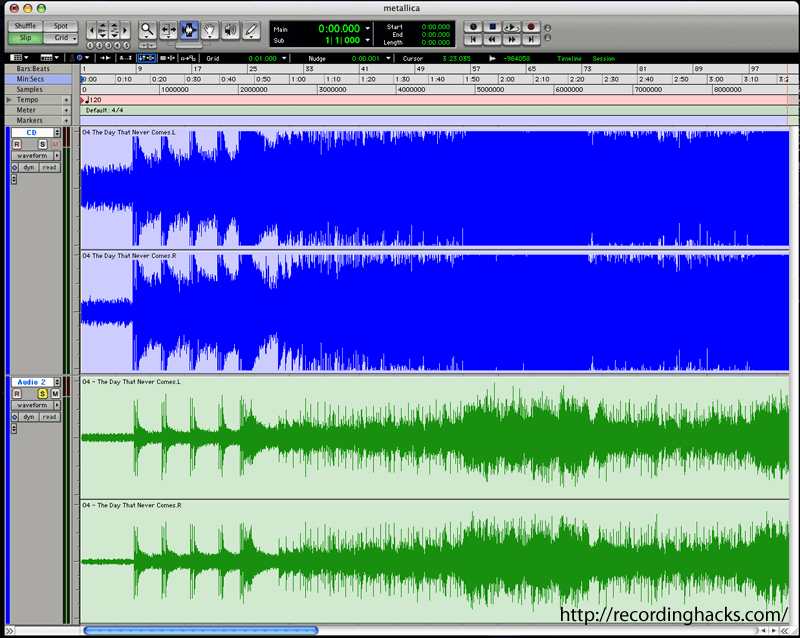 Visually, the difference is obvious. Once the drums come in, the audio level is practically pegged at 0dB for the rest of the song. There are no more dynamics to be had.
Sure, it’s a metal song. Maybe it’s just really that loud, you might be thinking. But no, the Guitar Hero mix shows plenty of dynamic range. And, not to spoil the surprise, it sounds a lot better too.
To be clear, the core problem with the Death Magnetic CD is not that it’s loud. The problem is that it sounds like crap.
Let’s do some comparative listening. There are two ways to do it: matched volume levels (in which the two versions sound equally loud), and matched gain levels (in which both versions are output at unity gain, and the CD version is a lot louder).
 |
The following clips are 320 kbps MP3s. Caution! The second half of the “equal gain” clip is much louder than the first half! Turn down your playback volume! Both clips contain an excerpt of the Guitar Hero mix followed by the same section of the CD mix of “The Day That Never Comes.” |
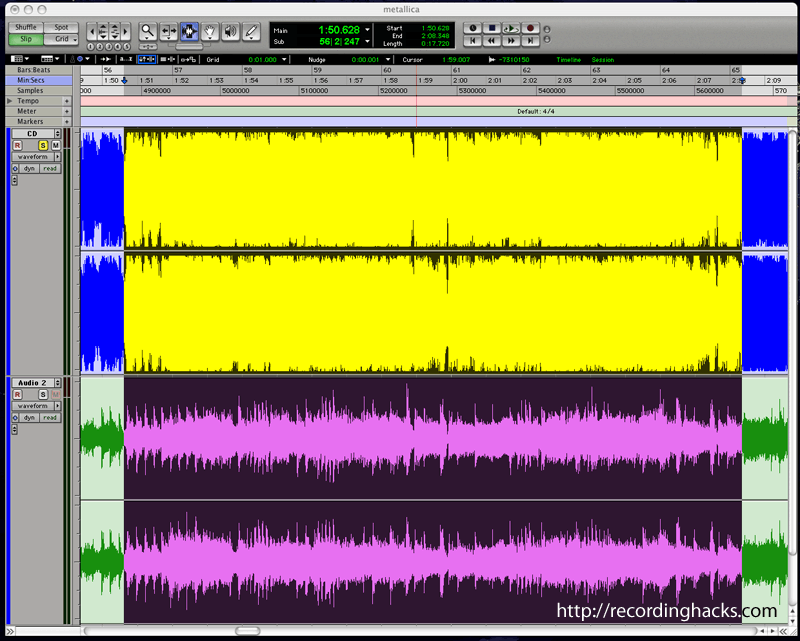 Here’s a picture of the waveform for the two mixes of this excerpt. The Guitar Hero mix (on the bottom of the screenshot) shows moderate changes in dynamic level, and plenty of transients. The CD mix, on the top half of the screenshot, is brickwall-limited — the entire segment is at maximum volume.
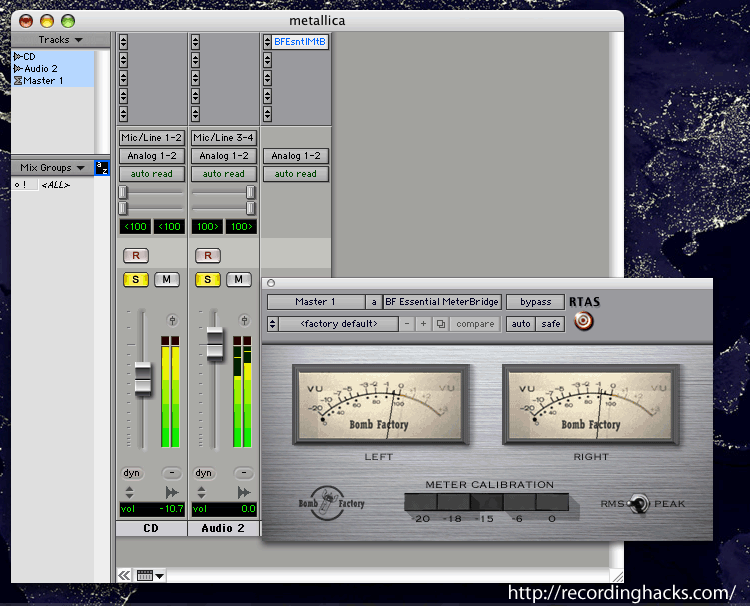
To match volumes for the “Equal Volumes” clip, I used a VU-meter plug-in in RMS mode, and reduced the gain on the CD mix until the two versions, panned hard L and R, were closely matched. The gain difference was staggering: 10.7dB! (see screenshot) A 10dB change requires 10x as much power to produce, and equates to roughly doubling the volume.
The “Equal Volumes” clip contains the Guitar Hero excerpt (at unity gain) followed by the CD excerpt (at -10.7dB). You won’t notice a change in playback level, but you will hear distinct differences in the quality of the sound. The distortion on the CD mix is apparent. Every snare drum fill makes my headphones sound broken. The CD mix is aggressive, for sure, but it doesn’t sound good.
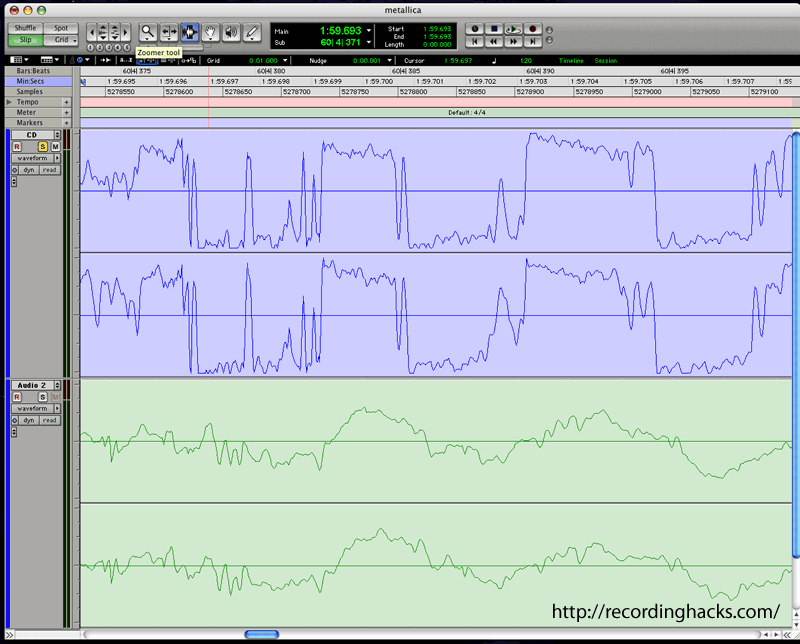 Zooming in to examine the waveform, it becomes obvious why the CD mix sounds the way it does. The relatively smooth waveform of the game mix is replaced by a jagged, exaggerated line. The rounded forms of the game mix are gone — there is nothing round about the CD mix, which is comprised almost entirely of vertical lines. The CD mix is comprised entirely of transients.
Curiously, the CD mix even has transients where the game mix does not — see the vertical spikes in the top waveform that have no corresponding spike below. That’s just noise: artifacts of the compression and limiting process.
Consider that the vertical changes in the waveform correspond to vibrations in the air, and therefore to the movement of a loudspeaker cone. The CD mix requires that your speakers spend the entire song oscillating between their maximum and minimum excursion points. Your eardrums, too. No wonder the CD mix is so fatiguing. Listening to the CD mix is literally a lot of work.
Paul Abbott, in his Tape Op piece, quoted a statement by Death Magnetic mastering engineer Ted Jensen in which Jensen claims no responsibility for the sound of the CD. I found the origin of this statement — a private email attributed to Jensen, posted without his permission to a Metallica forum and quoted extensively around the web.
I wouldn’t have been inclined to pin the blame for the CD mix on the mastering engineer, anyway; the few MEs that I know are uncompromising in their pursuit of fidelity. The only way they would output something sounding as bad as Death Magnetic is if the mixes they were given sounded worse. Which was actually Jensen’s point.
Lars Ulrich
Listen, there’s nothing up with the audio quality. It’s 2008, and that’s how we make records. [Producer] Rick Rubin’s whole thing is to try and get it to sound lively, to get it to sound loud, to get it to sound exciting, to get it to jump out of the speakers. Of course, I’ve heard that there are a few people complaining. But I’ve been listening to it the last couple of days in my car, and it sounds fuckin’ smokin’.
There you have it.
(Hat tip to Aaron Lyon for suggesting this story, and to TurnMeUp.org for general awesomeness.)
Related posts:

Tags: lars ulrich, loudness war, mastering, metallica, paul abbott, rick rubin, tapeop, ted jensen
Posted in Music Business, News, Technique | 50 Comments »
Brandon
December 25th, 2008 at 4:03 pm
It must be nice to have the certainty that Lars seems to have about everything. Of course, you’ll forgive me if I’m a bit leery of leaving judgments of fidelity to someone who’s been playing drums at stadium volume levels since before the advent of “quiet” in-ear monitoring.
He and the rest of the band are certainly well within their rights (and perhaps *are* right) to stand behind their record. But his pronouncements since the Napster kerfuffle all too frequently imply a derision, maybe even contempt, of the fans who have made Metallica a world-renowned band.
Aaron
December 30th, 2008 at 9:36 am
Really nicely done, M. I want to see the game version waveform next to the zoomed CD waveform, which is astonishing! Your observation about why it’s so much work to listen to a mix like this is spot on. I was surprised earlier this year to find Springsteen’s new album similarly smashed and instantly unpleasant because of it. Likewise the recently released Oasis CD. Haven’t looked for RockBand versions of these…
Julian
December 30th, 2008 at 8:11 pm
What I don’t understand is why there are two different mixes (it must be two different mixes if the trashing didn’t happen in the mastering) in the first place. I mean, if Metallica like their “new sound” or what Rick Rubin has done to their music so much, why did they agree to release a different mix for Guitar Hero??
matthew mcglynn
December 31st, 2008 at 3:13 am
Aaron, the zoomed-in waveform pic is there; just click the thumbnail to see it. or, here: http://recordinghacks.com/wp-content/uploads/2008/12/waveforms.png
Julian, it’s a good question — I thought at first that maybe the mix engineer produced one with and a second without such heavy limiting/compression, but it seems from some comments posted elsewhere that the mixes are actually different. Maybe nobody considered that the GH version would be something people actually listen to, meaning, it wasn’t given the same scrutiny by the producer?
Aaron
December 31st, 2008 at 8:53 am
Ah! Now I see the expanded screenshots. I missed that. UI suggestion: link color border (burgandy) for hot images, grey border for not. Cheers, -a
S Jansen
January 17th, 2009 at 10:51 am
Finally, an “in-yer-face” example for the general public of what many of us (who actually care about sound quality) have been lamenting for several years!
I can *almost* go along with the handful of producers who say that the mixes today have to be compressed like this in order to be heard above the (noisy) party or automobile environments. But not really.
I think the simple solution is to offer two mixes to the public: a “quality”/audiophile version, and a “fouled up”/party version. The industry could offer two separate cd’s (remember way back when one had the choice of a mono or a stereo record album?), or they could simply stick the two different cd’s in the exact same case. “Here’s one for your home stereo (quality), and one for your car to take to that rowdy party later (fouled up).”
Double-sided cd’s?
But, of course, the industry doesn’t care about giving us what we want, or giving us actual choices…it seems that this band doesn’t, either.
I can almost picture Lars whining, “Those internet pirates are just gonna turn this album into mp3s and ruin the great sound and rip us off – let’s ruin the sound before they even get the chance! That’ll show’em!”
Yup – they showed everybody, alright. Just look at those naked, ugly square waveforms. Ugh.
John S. Allen
February 22nd, 2009 at 5:13 am
Nice demo. I’m a member of the Boston Audio Society, which addressed this issue in a recent issue of its publication, the BAS Speaker. The limiting in the Metallica recording is far more aggressive than anything illustrated in the Speaker article, too.
One quibble, You say that “The CD mix requires that your speakers spend the entire song oscillating between their maximum and minimum excursion points. Your eardrums, too. No wonder the CD mix is so fatiguing. Listening to the CD mix is literally a lot of work.”
More to the point, clipping the waveform introduces new frequencies into the mix. These are the “crap” which makes the snare drum go “splat,” and makes listening hard work by obscuring the sounds of the instruments.
Radio stations maximize volume so they pop out of the road noise in your car and you won’t tune away. That’s understandable if not forgivable. But the CD experience is typically not one of channel-flipping, so what’s the point? Every playback system has a volume control. Most listeners are skillful enough to set the volume as they like.
The dynamic range of the Guitar Hero mix isn’t all that wide, either. The peaks even in the quieter sections are only a few dB down. It sure does sound better, though.
David
September 27th, 2009 at 9:11 am
Lars, sorry dude — you’re just wrong here. I’ve been a fan for years, but you can never justify loudness and clipping like that. It’s an insult to the faithful who buy your music. It’s a big “F” you, we don’t care what you think. The loudness war is greed. It’s engineers tripping over themselves to out-shout the other guy, the other song. It’s sacrificing the art for a bit more money. So some kid isn’t “disturbed” by having to reach down to his nano to turn up the volume a bit. Absurd. This is a great article, well presented and the second time I’ve stopped in to re-read it. A must read for every musician and every (open-minded) sound engineer. IMHO.
John
November 14th, 2009 at 3:07 pm
For cryin out loud guys…the Guitar Hero mixes are NOT MASTERED…Hello? They come packed as separate tracks–otherwise you couldnt play the game. I think even the kids know they are stems–how people in the business dont know this is beyond me.
Alex
January 1st, 2010 at 8:09 am
John, mastering a recording should make it sound brilliant, not turn it into a square-wave ear rape like the entire Death Magnetic album sounds like, it has NO dynamic range at all. Try listening to Pink Floyd who where way ahead of their time in mastering music with fidelity, it sounds absolutely brilliant and so much dynamic range. Majority of their songs do not go higher then -20 dB average which leaves room for very powerful sound effect. Death Magnetic is pretty much at 0 dB with no headroom, no dynamic range at all and the audio hurts my ears beyond belief. It’s one of the few albums I’ve heard that makes my ears feel tired and hurting.
Mastermeister
February 13th, 2010 at 4:44 pm
From many things I’ve read and from interviews, it’s clear that Lars fits the clinical definition of a Malignant Narcissist. Owing to that and years of stage sound levels far in excess of permanent hearing loss because he’s too vain to wear hearing protection, he is most likely also deaf, meaning that damn near anything turned up loud enough so that speakers emit smoke, will think “it sounds fuckin’ smokin’.”
Mastermeister
February 13th, 2010 at 4:51 pm
Alex has a point worth re-pointing: dynamics is a tool, a color on the palette of musical expression. To abandon it is to toss out an important musical element of expression. A good analogy might be to go on stage drunk and smacked out on speedballs. I did live sound once for Townes VanZandt, and watched as he nodded off on stage and fell off his stool. It did not earn him any praise for genuineness.
Ash
May 12th, 2010 at 6:50 am
it should be noted that games of the Guitar Hero narture, generally directly mix stems of audio (drums, guitars, vox, bass). Which means it mixing on the fly, usually without some incredibly heavy compressing in the mix buss (possibly some basic limiting)
So its not really that they gave out two mixes. Even with the same mix chain, stems probably wouldn’t produce the same amount of limiting/compression artifacts, and then mixing them after the fact might keep more dynamic range, than the full mix.
This could actually still prove that it wasn’t a problem created by the ME. But also means there’s more than jsut “mastering” or “multiple mixes” causing the differences.
anywa, I know this is an old article, just provided my inflated 2 cents.
Todd McMiniment
February 16th, 2011 at 11:48 am
Wow, this is a joke. I just bought this album via iTunes. It sounds like SHIT. Every track is distorted to the point of being almost irritating to listen to.
Lars, pull yer head out of your ass, wipe the shit out of your ears and you’ll realize it does NOT sound “smokin”.
I’ll never buy another Metallica album again if this is their “new” way of doing things.
I want my money back!!!
Ryan
September 10th, 2011 at 5:49 am
That’s crazy! I thought the difference between the equal gain option wasn’t going to be that loud, but it made me jump out of my seat! I just don’t understand why an sound engineer would output something to a CD at that low of sound quality. It’s unfair to the fans (who, if they keep this up, probably won’t be able to hear Metallica for much longer…) and it’s unfair to the band, whose vocal and instrumental skills are being completely distorted. I understand the need for digital audio, even though, according to die-hard audiophiles, it is at a lower quality. But this is absolutely unacceptable.
Jared
September 11th, 2011 at 1:38 pm
wow??? why would anyone put this into the public?? My step father has quite a few metallica cd’s including a live recording of the band in 1999. Even the live record that Metallica put out sounds alot better than this “new” sound. My headphones almost cant handle it! I guess the band just wanted a few extra bucks rather than to commit to their true talents.
Josh
September 11th, 2011 at 1:56 pm
I found it interesting that the louder version of the song sounded worse than the guitar hero version. I always thought that the louder it would be the better the sound quality would be. When i turn the headphone up on my ipod i find i can hear the bass and rhythm guitar better but I guess when you record it louder is does the opposite.
Reid
September 11th, 2011 at 3:27 pm
I’ve always been bothered by the sound quality of this album and it has alot of static and not much clarity. I think they should remaster this album and make a re-release. With all the money Metallica makes I would’ve hoped they could have put a little more time and money into a better production.
Tara
September 11th, 2011 at 5:39 pm
I’ve never really heard of Metallica until i read this, but it seems to me that their new CD doesn’t showcase the bands full potential. I mean, based on the two different comparisons, the sound from the CD sounds like its blasted and kind of flat or dry! Turning up the volume only made it sound worse, because the drums faded into just a bunch of noise. I liked the GH version much better because you could actually hear the difference in dynamics, and it had more of a variety of sounds. It’s almost like when you try to blow up a really small picture and all you get is the blurry pixels. The same happens with this bad sound quality.
Jordan Speicher
September 11th, 2011 at 5:57 pm
well ive never heard this album but from reading this article im glad i havent. I like some contrast in my music and not just a wall of sound. louder is not always better and this is one of those cases where thats true! my ears are astill ringing from the differences with the equal gains
Tyler Painter
September 12th, 2011 at 2:24 am
You know, I find it quite weird that artists/groups nowadays have this competitive need to trey and make the loudest song to essentially ‘beat out’ the competition- but really it’s just making their music sound worse! I saw how in the comparisons, the louder mix simply seems more distorted compared to the other track… Simply put, I’d much rather prefer a full-bodied, quieter song (heck, I can always turn up my speakers) than a distorted, super loud song!
Rodan
December 30th, 2011 at 4:12 pm
Oh, Metallica? The band who’s greed killed Napster? How quickly we forget. I haven’t. Don’t care how loud they get, ever, I won’t buy anything of theirs. They suck anyway; unless you’re 13-15 years old.
Takk
January 30th, 2012 at 5:43 pm
Rodan says: “Oh, Metallica? The band who’s greed killed Napster?”
Why is it classed as greed that they chose to do something about a network that actively allowed users to steal their product? Metallica were totally within their right to defend their own income stream and, as a producer myself, I’m damn pleased they did: not only for themselves but for us – the little guys – who are trying to make a living out of what we do and don’t have the financial clout to take on the Napsters/Rapidshares/Mega-Uploads/Pirate-Bays of this world ourselves.
I can’t say I like their music, but they will always be heroes to me for having the guts to take on Napster. The food on my child’s plate is partly down to them and I am grateful to them for that.
JMM
February 13th, 2012 at 9:10 pm
I think the fact that Lars’ reference system is in his car explains a lot.
Lauren Prager
April 23rd, 2012 at 11:31 pm
Ha! Just because it’s loud does not mean it’s better!
Dan
May 13th, 2012 at 12:15 pm
I like “The day that never comes” song, especially the guitar solo in the end. After hearing to the guitar hero version I am disappointed that Metallica distorted the sound. Where can I get the better version of Death Magnetic?
CeeVee
July 19th, 2012 at 1:33 pm
I remember back when Protools was just a 2-track mastering program and everyone was so stoked that they could make their mixes sound “louder” than everyone elses with the plug-in comps, limiters, maximizers, etc that it originally came with. You could really mess up a good, dynamic mix with that crap, and it’s being done all day long in the name of being “louder” ? Those older Bob Rock mixes sound real good, so, wtf ?
Pierre-Alexandre Sicart
September 18th, 2012 at 1:45 am
Louder than *what* exactly? This remark only makes sense in the context of a radio broadcast: you compress like hell to out-scream the competition. But on a CD album? Even if you want to beat the rumble of traffic, a few decibels won’t make a world of difference.
Pierre-Alexandre Sicart
September 18th, 2012 at 1:48 am
… on the contrary, since you create your own rumble, devoid of clarity. Music, traffic noise, everything becomes mashed together.
Ben
June 17th, 2013 at 11:06 am
In the equal volumes clip I can barely tell the difference between the two mixes.
Mike
September 2nd, 2013 at 7:28 pm
Well, I may not be college educated, but ever since I started recording, I knew you wanted to AVOID clipping. And this process, especially using a MAXIMIZE type plug-in, takes clipping to a whole new level. A big pointed finger for all these new age producers: I used maximize ONCE in a song. I recognized it as a mistake and never played with it again. Use your brains people. We were all drunk kids in a basement figuring this shit out when we got it right, do you really think it takes all this crap to make it sound good? It doesn’t. It never will.
Chad
September 27th, 2013 at 3:56 pm
Good thing you’re not an audio engineer, ben. (I hope so anyway )
Philip
January 24th, 2014 at 8:01 am
Thanks for this article, I just purchased this album and thought maybe I had corrupted download files. I am not an auditphile but at times when I’m listening to this album I cringe. It just sounds like fuckin’ shit/.
Dan
March 13th, 2014 at 10:16 am
“I’ve been listening to it the last couple of days in my car, and it sounds fuckin’ smokin’” – Lars Ulrich
Yea, let’s trust the deaf guy rather than our own ears, where the problem is quite apparent.
Luis Lozano
March 14th, 2014 at 2:09 pm
Long time Metallica and general guitar music all around for a good 40 years and when we got the pirated copies of Desth Magnetic we went and bought the real ones… after we finished laughing at what they did to their own art we moved on… sometimes bands.. musicians.. artists.. actors..etc produce total art the wrong way… thats life…. hope they bring another Lou Reed albumn out… we had such a larf there too.. oh Spinal Tap where art thow? ( pun intended)
Tony
March 14th, 2014 at 2:32 pm
How exactly does a 10dB increase in volume require 10x as much power to produce and double the volume? Spectral and waveform levelers peak at 0 in most of today’s recording software and measure down, while monitors can go from -30 to +15.. Amplifying a clip by 10dB doesn’t require jack to produce; it’s all done digitally, and it by no means doubles the volume. The reason the studio CD sounds like shit is simply because whoever mixed it jacked the volume past the peak threshold, which any self-respecting producers knows never to do. That slightly distorted sound you hear? That’s the waveform clipping out during playback. Amplifying it down doesn’t reduce it, because the damage is already done. Simply put, the album was well-recorded for what Metallica is today,but its producer turned it into shit by making a rookie mistake.
matthew mcglynn
March 14th, 2014 at 8:13 pm
@Tony – “How exactly does a 10dB increase in volume require 10x as much power to produce?”
That’s the physics. According to wikipedia, “A change in power by a factor of 10 is a 10 dB change in level.”
“Amplifying a clip by 10dB doesn’t require jack to produce; it’s all done digitally, and it by no means doubles the volume.”
I think you’ve misunderstood the point about power requirements. But the essence of that passage is about perceived loudness. Loudness perception s subjective, so there is no absolute answer here. But 1 bel, or 10 dB, is generally accepted to represent doubling (or halving) of perceived volume.
jay
January 12th, 2015 at 11:22 pm
Rodan says: “Oh, Metallica? The band who’s greed killed Napster?”
you know how music is so personal?….how you feel when someone says your favorite band are worthless hacks and posers? imagine how you would feel if you were in that band and wrote that music and someone said its so worthless that no one should have to pay for it to hear it.
Lee 1971
January 28th, 2015 at 4:20 pm
Metallica’s ‘Death Magnetic’ is the poster child of horrific dynamics, this thing will make your ears bleed. I’m a pink floyd fan and know nothing about metallica, but I like to know there is great sounding albums in the world. All is not lost though; ‘Kill ’em all’ original 1985 CD has fantastic dynamics.
This Lars guy is point blank wrong on this one, it cannot possibly sound anywhere approaching good….but then again, he’s bound to say that, right?
Check it out at; http://dr.loudness-war.info
Hugh Jass
April 20th, 2015 at 5:24 pm
Howdy, folks. I’m a longtime Metallica fan, having bought “Kill ’em All” shortly after its original ’83 release. I saw them on the tour that cost them Cliff Burton, and two more times after that, the last being the “…And Justice For All” tour. I ceased interest in any new material after “Load” was a huge disappointment. So, until the above clips, I’d not heard anything from “Death Magnetic” but the poor audio quality brings up an interesting comparison.
I read this very-old discussion and was very surprised to find not a single mention of “…And Justice For All”, Metallica’s other aural disaster. If you’ve not heard it, it’s a great Metallica album that I (and many others) find nearly unlistenable because of the mixing. Nothing wrong with the volume, it’s just mixed so incredibly badly. It’s very tinny sounding, and I find it fatiguing (the latter being a similar complaint about “Death Magnetic”). In concert, it sounded fantastic. I’m not a fan of live albums but I actually hoped for one in this instance. The studio release is really THAT bad.
Here’s what’s interesting about it: at least one person involved in “…And Justice” points the finger squarely at Lars himself. The guy couldn’t believe Lars wanted it to sound like that, and actually didn’t want to sign off on it–but it might have been a career ender for the guy so he did. Clearly, Lars didn’t have any idea 25 years ago how an album should sound through a good system, so the “hearing loss” argument is not only viable here, but is very possibly retroactive a quarter of a century. I think Lars literally can’t hear the upper spectrum of frequencies worth a damn, and hadn’t been able to for a couple of decades by the time “Death Magnetic” was released.
So I have an experiment for you: find a lossless, unfettered original sample of any track from “…And Justice For All” and listen to it on your reference system. Afterward, throw a couple of medium-weight blankets over your speakers and listen to the same sample again. I think you’ll agree it arguably sounds better. That’s what I think it sounds like to Mr. Ulrich, and since in his mind he’s the only one that matters, he’ll damned-well dictate how it’s going to sound to the rest of us who haven’t been standing next to a running DC-10 for 35 years without ear protection.
punkenheimer
May 9th, 2015 at 8:26 am
Hugh Jass, lol. Couldn’t agree more.
But that said, I really don’t understand why the other band members would approve of it? Well, everyone knows Lars is an asshole, probably a deaf one as well…, but why, oh why the shitty recording?
TBH, only their first 3 albums, a few live recordings here and there, and a few old recordings on ‘garage’ are good sounding, everything else is crap. Great music destroyed by poor mixing/ recording since the mid ’90s.
Metallica really need to take a leaf off Iron Maiden’s book when it comes to consistency of recorded sound.
punkenheimer
May 9th, 2015 at 8:32 am
P.S, I ended up on this page after googling; “why are Metallica recordings so shitty”. I might be an Iron Maiden loving English puke, but,
I’m a ‘tallica fan as well…
No offence.
What?
June 5th, 2015 at 4:45 am
They should have named the album Deaf magnetic.
Seculla
December 7th, 2015 at 7:16 am
LoL, Deaf Magnetic it is 🙂
If Lars really thinks what he said, then his ears have probably gone bad from all the stage noise over the years. You must be a 3 year old not to notice there is something very wrong with the outcome.
Metallica wins denial wars. Is seems to be hard to admit you’ve done something wrong ….
Art
September 15th, 2016 at 3:26 pm
The ear naturally compresses sound at 500 Hz and up, so if you ever want to “uncompress” some music, just pull down the EQ frequencies above 500 Hz (high-shelf, -1 to -3 dB) and maybe you’ll actually enjoy it better!
Gary
April 3rd, 2017 at 7:54 am
I wonder about a few different thing related to this subject. Is this in any way familiar to Beats Audio? I bought a cheap ass throw-away temporary PC with this on it and after reading a bunch of complaints, the conclusion was that this Beats crap was placed in it to sell more laptops. Because we all know the “WOW” factor that the average person falls prey to. Greed, I agree!!! You guys as audiophiles and or engineers appreciate good sound. If I remember correctly, vinyl years ago had the low frequencies identical on the left and the right tracks. Maybe they still do. Had a debate about it and my side was that in a traditional band stage set up, the bassist is on the left and guitarist on the right. I’ll throw a number at it but it is a guess, let’s say 75% of the time. I like to image the band as I listen. And my friend said to me, ” if a girl is out on a dance floor but closer to the guitarists side, she might be out of step with the beat. So just put it up the middle, it will save time and money from the cost of all that mixing and mastering. Well, we are no longer friends because of this. His approach is like Common Core, everybody gets a trophy. I am not a professional but love the arguments on the perspective, to me and I know to guys as well, it is an art form in addition to the band and their performance. It’s dying, sadly, but that’s what happens when you make everything equal in the butterfly and unicorn world of the people running the industry nowadays, compared to the good old days. Keep up the fight, I still agree with most of you.
John Choody
April 23rd, 2017 at 10:32 pm
Dear Metallica. I have paid (did not STEAL from Napster) for the DM to get crappy sound quality. And it struck me at the first hearing. Where the heavy quality Metallica sound has gone? It sounds exactly like it was recorded with old tape recorder with automatic microphone level adjust which could not have cope with drums high level sound so these sound crappy. Luckily the GH version saved the day. Thanks heaven that HTSD sound is OK. Thank you for listening complaints 🙂
Not Lars
October 4th, 2018 at 6:26 am
I think it sounds great
Chris manning
November 3rd, 2018 at 8:05 pm
They needed multi track stems for the different channels needed for audio playback. I think they mixed into 6 tracks. Vocal, guitar, bass, drums, solo guitar, other
Chuck
March 24th, 2019 at 7:40 am
Metallica (read: Lars Ulrich) wouldn’t know “smokin'” sound if it hit him in the face – which it probably has.
Compare the shit production on any Metallica record to genius producing like that of my favorite band, The Who. Blows Metallica’s out of the water.
Lars is a dummy, always has been.