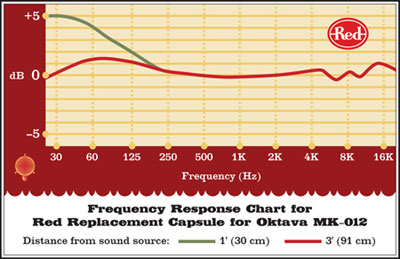
Pricing & Availability
- MSRP: $325
Tags
Reviews & News
- Counterfeit Oktava news
- Sound On Sound, 1994-07
- Video mic shootout
- vs. SF-1 Ribbon
- vs. sE1a, Recording Mag 2005
- Electronic Musician, 2000-03
- Michael Joly Capsule Review
- Mojo Pie review
- Scott Dorsey MK-012 mod
- vs. Beyer MC 930, Drum OH Rvw
- vs. LCT340, MC930, Review
- RH Drum OH Review
- Figure-8 Capsule Head review
- Tape Op Review (issue #25)
MK-012 Documentation


 Oktava MK-012
Detachable-Capsule Pencil Condenser Microphone
The MK-012 was designed at NIKFI Research Lab, the Russian Scientific Research Cinema & Photo Institute, in 1963. It is one of the favorite pencil condensers of the online forum crowd, due to its reputation for besting more-expensive microphones in numerous studio applications such as drum overheads and acoustic guitar.
The mics are available singly or in matched pairs, in matte silver (nickel) or in black.
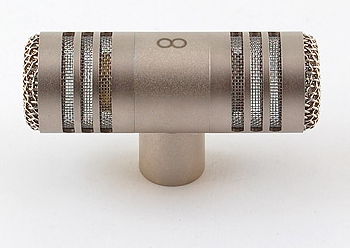 The MK-012 body is one of the most versatile microphones on the market today, given the wide variety of compatible capsules. Oktava manufactures small-diaphragm end-address Cardioid, Omni, Hypercardioid, and Figure-of-8 capsules in Tula, Russia, as well as a variety of medium- and large-diaphragm capsules, both end-address and side-address. Aftermarket capsules are available from RTT and, until recently, from Red Microphones (aka Blue Microphones). See a full list below, and our Oktava capsule analysis (a listening test of all large- and small-diaphragm capsules for the MK-012).
 The mic is typically supplied with one or more small-diaphragm capsules, a -10dB pad, and a metal mic clip. An inline HPF, which like the pad can be screwed into the body ahead of the capsule, is available separately, as are a variety of shockmounts. (The MK-012 body can also be purchased with one of Oktava’s medium- or large-diaphragm capsules, but in those cases the model number changes; e.g., the model MK-103 is an MK-012 body with Oktava’s new “103” 19.5mm capsule.)
In 2007 the company introduced a “film edition” of the microphone, which bundles the basic preamp body with a hypercardioid capsule and the aforementioned detachable high-pass filter — but no -10dB pad. Foam windscreens are also available.
Is the MK 012 the same as the MC 012?
This microphone was originally named MK 012; the MK prefix is an abbreviation of the Russian phrase for “Condenser microphone” (Микрофон Конденсаторный). When the mics were initially exported to the West, the prefix was changed to “MC” at the request of UK importers A & F McKay Audio Limited.
When the distribution agreement with the McKay brothers expired in 2004, the manufacturer reverted the microphone name to its original “MK” prefix.
Has the MK 012 amplifier circuit changed?
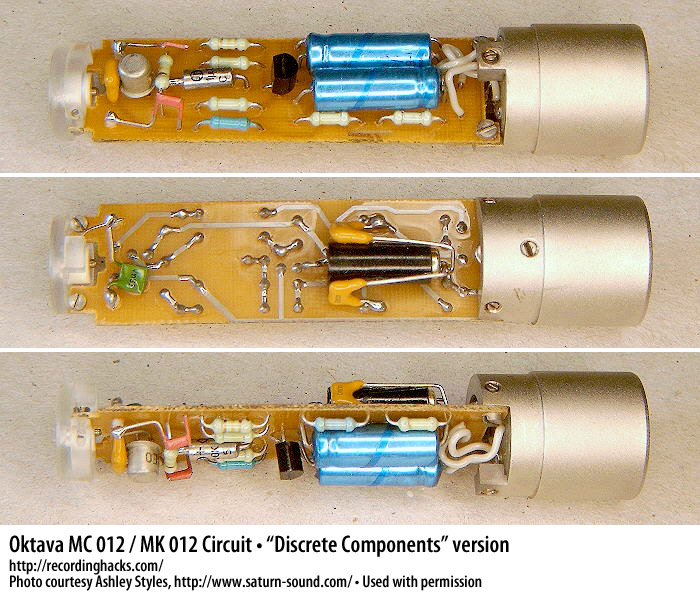 The photo at right shows the current-production MK 012 amplifier circuit. We believe this design was implemented in 1992, and would have been used in all the MC 012 microphones as well as the MK 012 microphones manufactured since 1992.
(PCB photo credit: Ashley C. Styles / Saturn Sound)
Has the MK-012 capsule design changed over the years?
According to Oktava, early MK-012 capsules used glued diaphragms. In the mid-1990s, the factory began using screwed diaphragms, one of the benefits of which was additional shockproofing.
Can the MK 012 be modded?
Much has been written about the “Dorsey mod,” which was published in Recording Magazine in September 2003. Microphone guru Scott Dorsey revealed a series of component upgrades that he thought would make noticeable improvements to the sound of the mic.
Scott Dorsey
With the Oktavas the electronics are actually very well designed and pretty ingenious, and there really aren’t too many substantial topology changes that need to be made… but there are some things that can be cleaned up.
The article has recently been republished online; see the link in the sidebar. Note, however, that the parts list in the article is now out-of-date.
See the sidebar for contemporary mod options.
If you are shopping for MK-012s, be aware of the “counterfeit Chinese Oktavas” controversy: briefly in 2005, the UK-based importer of Oktava microphones — confusingly known as Oktava Ltd — outsourced manufacturing to China and signed a distribution deal with Guitar Center in the US. The Chinese ‘012s can easily be distinguished from the original Russian-made models; see the official and authoritative fake-MK012 photos from Russia. Within a few months of hearing the backstory, Guitar Center blew out the remaining inventory and has not carried the product since — whether due to a refusal to deal with Oktava Ltd, or to Oktava Ltd’s questionable rights to the microphone design, is unknown.
The Chinese MK-012s sounded fine, by most accounts. It is not known whether they respond to the circuit mods that are readily available for the Russian-made mics.
Read more about the Chinese Oktava story, including an interview with Andy McKay of Oktava Ltd., here.
By our estimates, retail prices on the MK-012 have risen nearly 40% since late 2005, due no doubt to increasing demand for this microphone. Unfortunately, the days of $89 blowouts at Guitar Center seem to be a thing of the past.
In 2008, Oktava began shipping two new MK-012 kits, in which the MK-012 amplifier body is bundled with a variety of SDC and LDC capsules:
- MK-012-10 - consists of a single MK-012 body, three SDC capsules (cardioid, omni, hyper), one LDC capsule (the MK-101, a side-address design that uses the large-diaphragm capsule from the MK-219/MK-319), the screw-on -10dB pad, and a mic clip.
- MK-012-20 - as above, with an MK-102 capsule in place of the MK-101. The MK-102 is an end-address 27mm design.
Electronic Musician, 2000
Like its fellow Russian-made mic, the Elation KM201, the MC012 performed consistently well in all applications — in some instances sounding nearly identical to the KM201. Overall, the sound was smooth, warm, solid, and nicely balanced. The only noticeable hype was in the low mids, which accounts for its consistently warm but sometimes muddled sound.
Find a schematic for the MK012, with suggested upgrades, within the Yahoo “Micbuilders” group file archive (here).
The Oktava MK-012 is also known as: MK 012-01, MK012.
The mic was released in 1963.
Specifications
| Compatible Capsules | ||||||||||||||||||||||||
|---|---|---|---|---|---|---|---|---|---|---|---|---|---|---|---|---|---|---|---|---|---|---|---|---|
|


| Pads & Filters | Impedance | SPL/Noise |
|---|---|---|
|
300 Ohms (Low) | Max SPL: 130 dB |
| Weight | Length | Max Diameter | Interface(s) |
|---|---|---|---|
| 85g (3.00oz) | 123mm (4.84'') | 23mm (0.91'') |
|
| Power Specifications |
|---|
|
Did we get anything wrong on this page? Please let us know!