
Internal kick-drum microphone mounts
Saturday, January 24th, 2009 | by matthew mcglynn
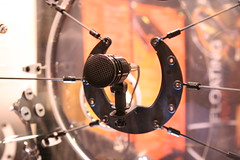 In my first 30 minutes at the winter NAMM show, I saw two neat kick-drum products. This is the story of the first one, the Kelly Shu.
(UPDATE: the other kick-drum product I saw is called the KickPort.)
It is the world’s first portable, permanent isolation mount for an internal kick-drum microphone. It looks like a horseshoe (hence the name Shu) suspended in the middle of the drum by bungee cords.
 When my band was gigging, I grew weary of the haphazard approach to kick-drum miking employed by the soundmen at the (admittedly low-rent) clubs my band would frequent. Usually there would be a floor stand with a D112 (or, on less-happy days, an SM57); it would get shoved unceremoniously into the hole in the drum’s front head. Wherever it landed, that would be the kick sound for the evening.
And probably it would be fine, or at least, it wouldn’t stand out as the first thing a professional engineer would fix. But I longed for an upgrade — for a nice mic, permanently installed, in a position that I’d optimized for the specific drum, tuning, beater, and playing style.
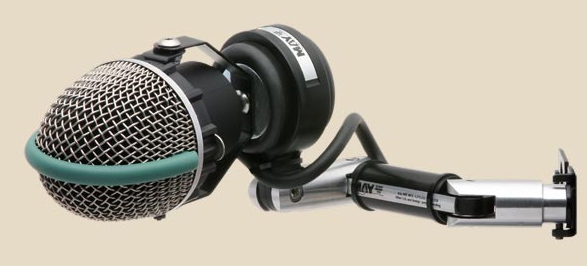 I had read about the May internal mic mounting system, and it seemed ideal. I eventually bought one of May’s kick-drum mounts, complete with D112. It’s been mounted inside my bass drum ever since.
But, in my experience, it doesn’t really deliver on its promise. The mounting arm works itself loose over time, and is impossible to correct by reaching through the small hole in the front head. I could take the head off to adjust it, but that sort of defeats the purpose of the thing.
I loved the idea that once I’d dialed it in completely, I’d get a perfect, reproducible kick sound simply by attaching a cable to the XLR jack on top of the shell… Unfortunately, the limited range of motion of the mounting arm, and the device’s tendency to work loose, have prevented me from either finding the ideal position or from keeping the mic in one place.
Another challenge for this system is the lack of vibration isolation. There is a rubber isolation mount that allows the mic to float to some degree, but judging from the sound of recorded tracks it seems like I get a lot more attack than I should, as if the shell resonance is being transmitted mechanically through the mounting arm.
The Kelly Shu addresses some of these issues — most significantly, it is a true isolation mount. The mic holder is literally suspended by elastic cords.
Positioning is less limited than with the May mount; by varying the length of the cords and the orientation of the Shu, as well as the position of the mic on the Shu, it looks like it would be easy to locate the mic anywhere in the middle 80% of the drum. For positions close to the shell, the May would have an advantage in positioning. (That said, I’m not sure anyone mics a kick drum near the shell.)
 To be fair, my experience with the May system is not universal. The May mount has been used by countless touring bands with great results. For example, I spotted it recently in the Neil Peart DVD, Anatomy of a Drum Solo
But Paul Northfield isn’t miking my kit, and Lorne Wheaton isn’t setting it up. So I’m ready to swap my May for the Shu. Installation and initial adjustment might still be fiddly, but it’s certain the mic will be mechanically isolated. And, given that the Shu mount is getting pulled by elastic cords in all directions at once, there’s not much chance its position will drift around once it has been set up.
There are two Shus to pick from — an anodized aluminum model that comes in different colors for about $100 street, and a high-density fiberglass model that streets for under $50.
I’d love to hear reactions from May and Shu users; please comment below!
Related posts:

Tags: kelly shu, lorne wheaton, neil peart, paul northfield
Posted in Microphones, Technique, Video | 15 Comments »
Slau
January 29th, 2009 at 2:07 pm
I, too, saw the Shu within the first hour while planning some interviews for the podcast. The fiberglass version was quite rugged enough. I think I’ll go for one, for sure. I didn’t seem like it was terribly adjustable after the initial mounting but, for what it’s worth, I’m usually in the same ballpark with a stand each time anyway.
BamBam
March 14th, 2009 at 5:06 pm
I have examined the Kelly Shu and the May Miking system.
As knowing a good thing when I see it I bought a Shu around the time that they hit the street. I have been extremely happy with it’s isolation and overall “does what they say it will do”. I have heard and seen potential problems with the isolationism of Randall May’s system.
But as far as I know, there’s only one internal system for toms and that’s The May Miking System. If there is another out there, please shout it out loud. Thanks.
Bam!
matthew mcglynn
March 14th, 2009 at 7:42 pm
I have not seen alternative internal mic systems for toms (other than the May, I mean), but I will surely cover it here if Kelly or someone else comes up with one.
Robonzo.com :: Recording and Rehearsal Prep
March 15th, 2009 at 8:49 am
[…] turned me on to a new product for bass drum mic placement – the Kelly Shu. Here’s the great review by […]
Brian Jones
December 27th, 2009 at 7:43 pm
I have MAY mics on every drum, I noticed it hasn’t been consistent in sound in different rooms, you’ld think the isolation of being inside wouldnt affect that however in some rooms I get a killer full sound but in others I get a hollow ambient sound almost like it’s out of phase, so Im keeping the mics and selling the mounts….(or maybe sell the mics too)
Owen Bonaventura
January 8th, 2011 at 7:51 am
I have the May system. It works fine, but there is definitely a lack of adjustment and isolation. I’m thinking about getting the Kelly Shu because it provides much more isolation. Neil Peart switched to the Shu on his recent Time Machine tour with an Electro-Voice RE20 mic.
Rob Venditti
March 13th, 2011 at 12:41 pm
I just bought the KELLY SHU internal drum mic setup and it works great, played my first show with it this weekend and it sounded great,i used it with my BETA52A, no problems with movement so far, it stayed in the same place i put it. I spoke with the owner directly who answered all of my questions. It took about a half an hour to install, it was very easy to do and i would recommend this product.
Pete Roberts
April 13th, 2011 at 3:16 pm
I have the May D112 in My kick and have no problems sounds great and no real movement problems. I also have a May SM57 which used to be in my snare, but i never really got a good sound, now I have taken it out and screwed it to a mic stand and use it externally. works very well with great shock mount and compact size. In my Tom I have a system which you used to have here int he UK called Drummik. They where low cost internal mics. I must have had them for 15 years and still working and I think they where only £30 each !!! They sound great for small pub gigs etc. but for larger venues and better sound systems I use 57’s
Shannon
September 13th, 2011 at 9:22 pm
I have had the May miking system in a set of Dw drums since 2000.I have to adjust the set screw which is a left handed threaded screw in each drum once or twice a year but its worth it!They sound great and i get compliments from every sound guy i have ran across.I have had no problems with the mount moving…Also u can tightenthe parts up with a allen wrench if needed for the joints,
Ric Martelino
December 16th, 2011 at 9:25 am
I’ve been a Regional Artist endorser for the MAY EA miking system since 1987. I haven’t had any major problems, except for the afore mentioned loosened screws and such. I’ve used the system in both live and studio situations with great success. Less experienced soundmen were intimidated at first, but found it easy to work with.
In the studio, for the toms we would blend the internal sound source with external for an enahanced overall sound. For the kick drum we would use the internal D-112, with a YAMAHA sub kick, and an EV RE-20 about 6 feet away within a tunnel, all blended together.
I’m sure the Shu is a fine product, I wouldn’t be surprised if Randall May develops something similar
John Powell
February 13th, 2012 at 10:28 pm
I have used May Systems out on tour and 5 out of 10 shows I would have to adjust the mic position because of movement.. I moved over to The Kelly Shu, and the unit stays in place all the time… I use the Pro and Composit… and just picked up the new Kelly Shu Flatz that holds any boundry kick mic… It keeps the mic off the padding. I’ll be using the Shure 91 on the Flatz with a Audix D6 on the Pro. This double set-up is also being used on the 2012 Van-Halen tour.
Robellion
April 18th, 2012 at 3:58 pm
I have the Kelly Shu in all 3 of my kick drums, my larger double bass kit as well as my smaller single kick. They have never let me down! I’m in the process of trying to use the Shus in some of my toms as well. I would prefer to have all of the drums miked from the inside. The kicks are miked with Audix D-6’s and my toms and snare are miked with Audio Technica mics.
TXMusicDrummer
May 4th, 2012 at 11:22 am
I agree with some of the other posts. When it comes to toms, May is still the best way to go. I’ve utilized both the XL57’s and a Beta 52 in the large tom. I love the sound of the Beta 52, but that’s a real heavy mike, and I’ve had many problems keeping it in place. The 57’s work a lot better. Only time I’ve had to adjust them is when I replace the heads, and only very slightly at most. As for snare, I do have the XL57 pointed at the snares, and it works ok for live stuff; however, for studio work, I gotta have a top external mike mixed with it. I’ve used the Beta 98 and have mixed both internal and exteral mikes with the INEX Blend Module and have gotten great results. One thing I would really like to try is to utilize the Shure Beta 181/BI with the May mounting system. Have it positioned to where the mike equally picks up both the attack and the snare wires. As for the kick, I haven’t utilized either the May or the Kelly Shu system. My mike of choice has been the Shure Beta 91 placed on the inside of the kick. That mike does wonders for my kick drums. In the very near future, I will mount that mike onto the Kelly Flatz unit. I’ll post my feedback in the near future.
Jon Dittman
September 16th, 2014 at 9:37 am
One word on may mount screws working lose.
Loctite.
I have been using May mounts in toms, snares, and bass drums for over 14 years and lots of gigs. Only once have I had a minor issue with slightly lose screw in bass drum mount/D112.
Cary
January 3rd, 2015 at 12:44 pm
I wonder why a smaller version of the SHU couldn’t be developed that lays parallel with the heads on a tom? Seems like this would work great to me. I am going to make a ply and fiber glassed prototype and see how it works. I think , if estimates are correct, it should only cost about $10 US to make.